High School
“Aiya! Can these cars move any slower?” Jenny’s mother clicked her tongue and honked the car horn in frustration.
Jenny looked up from her iPad, her eyes swimming. She’d been reviewing AP Economics flashcards for the past hour. During that time, their car had barely moved ten feet in the Lincoln Tunnel traffic.
“Ugh, mom,” Jenny sighed. “How long are we going to stay at Po Po’s today? I have, like, three tests next week, and AP exams are in a month.”
Even as she said it, Jenny knew her question was unfair. They hadn’t visited Po Po in two months because every weekend had been fully packed. If Jenny wasn’t at orchestra rehearsal, then she was at swim practice. And if she wasn’t at either of those, she was picking her way through a mountain of essays, lab reports, and problem sets.
Jenny’s mother gave her a sharp look, but she softened her gaze when she saw the dark circles under Jenny’s eyes. “We’ll stay until lunch, and then we’ll go home.”
After an eternity, they finally parked on East Broadway and made their way up to Po Po’s apartment. Jenny felt like she was going to vomit from spending the entire car ride reviewing terms like scarcity and efficiency and opportunity cost. The opportunity cost of spending today in New York, Jenny thought groggily, was being unable to finish her homework in the comfort of her own air-conditioned room.
It took three doorbell rings instead of the usual one for Po Po to open the door. When Po Po finally answered, Jenny wasn’t sure if her nausea from the car ride was making her hallucinate. Had her grandmother’s shoulders always been that stooped? And had that patch of thinning hair always spread to her ears?
“Mei Mei zhǎng gāo le!” Po Po said, by way of her usual greeting. But her voice sounded tired. And yes, Jenny was definitely still growing, but was Po Po shrinking? She did not remember towering over Po Po this much when she last saw her two months ago.
“Po Po, it’s been so long!” Jenny said in reply. She paused, wanting to say a bit more and ask politely about her health, but she wasn’t sure how.
Po Po ushered Jenny and her mother inside. Jenny noticed that the plants crowding the windowsill drooped from neglect. The Chinese newspapers, which usually rested in a neat stack on the coffee table, were haphazardly strewn about. Jenny looked over at her mother, whose lips were pressed in a tight line of worry.
The three of them sat down to eat. At least the three bowls of wonton soup sitting on the dining table were a familiar sight. But as soon as Jenny bit into a wonton, her eyes watered from how salty they were. Po Po’s food was never salty.
After several minutes of eating in silence, Jenny’s mother cleared her throat. “Mom,” she began carefully in Mandarin. “You don’t seem to be doing very well. I really think you should move in with Jenny and me.”
A flash of anger crossed Po Po’s face, and Jenny’s gut suddenly twisted. It struck her as strange, seeing Po Po’s always smiling mouth contorted into a frown.
“No,” Po Po said. “How many times do I have to tell you? The answer will always be no.”
Recently Jenny had been priding herself with her improvement in Mandarin and Cantonese. Paying attention during her high school Mandarin classes helped, as did watching the occasional Hong Kong drama. But the conversation between her mother and Po Po soon devolved from their typical Mandarin-Cantonese blend into a flurry of Cantonese that she couldn’t fully understand.
Jenny’s mother grew more and more desperate, and Jenny picked out phrases such as “your declining health… early dementia… my obligation to care for you.” Po Po, on the other hand, was shooting back words like “boring suburbs… no independence… health will worsen quicker.” Po Po’s voice had a barbed edge that Jenny had never heard before. She felt as if the temperature in the already warm apartment had risen five degrees.
Then the argument stopped as quickly as it had begun. The two older women looked down at their bowls and refused to look at each other. A beat passed, then two, and suddenly the awkward silence was too much for Jenny to bear.
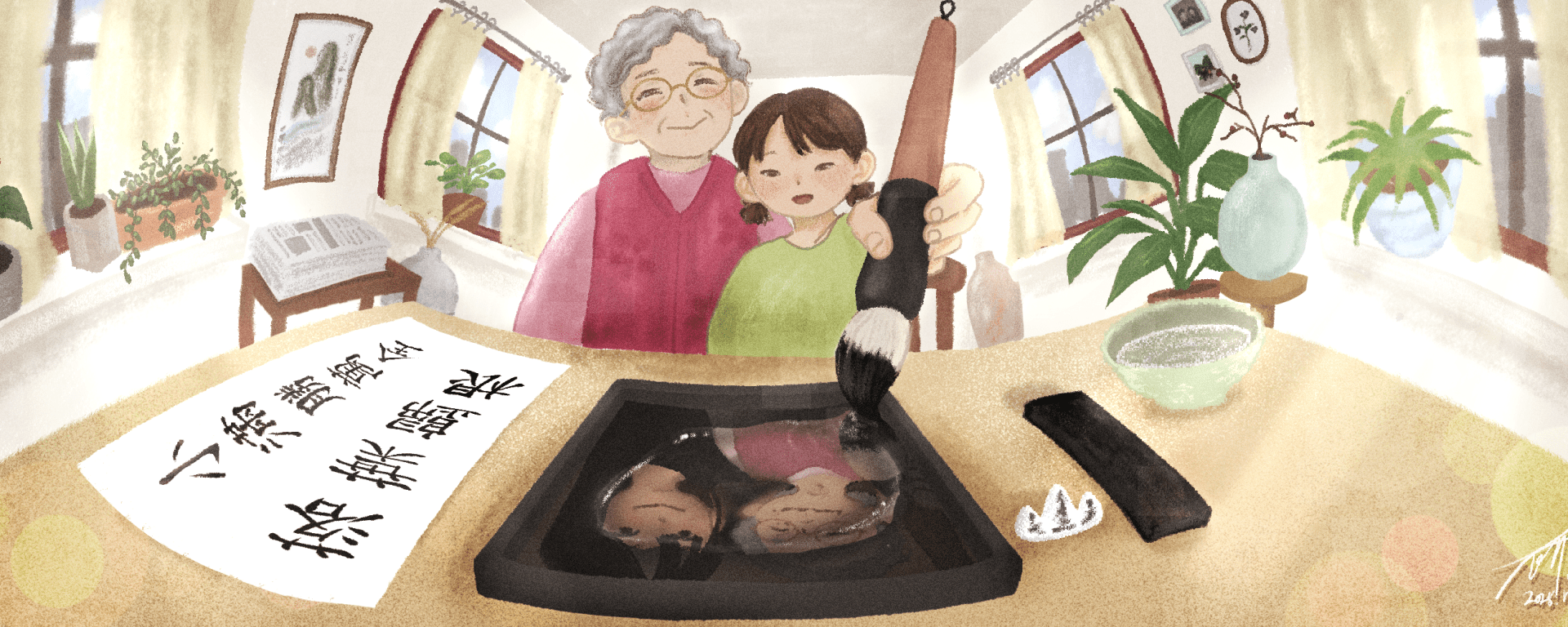
“Po Po, let’s write calligraphy,” she blurted. She had to diffuse the tension, and this was the only way she knew how.
Po Po looked up at Jenny, her eyes unfocused and glassy. “Yes,” she murmured, more to herself than to Jenny. “Yes, I’d like to write calligraphy too.” She rose and made her way over to the cabinet, fumbling with its glass door. Hands trembling slightly, she took out the paper and brushes, then groped around for the inkstone even though it was right in front of her. Jenny rushed over and gently took the items from Po Po’s hands. As she carried the supplies back to the dining table she caught her mother’s eyes, sad but thanking Jenny in silence.
Just like that, the plans for leaving Po Po’s apartment after lunch flew out the window. Jenny knew she’d have to work extra hard to catch up on her homework when she got home, but right now her main focus was on the brush and paper in front of her. She itched to say more to her grandmother, but any questions she took minutes to painstakingly form in Mandarin died in her throat when she glimpsed Po Po’s sullen face. So the two of them spent the rest of the afternoon quietly dipping their brushes in ink. Only Po Po’s occasional reminders to hold the brush straight and the rustle of rice paper would break the silence.
 Katie Tan