Elementary School
“I don’t want to see Po Po!” Jenny yelled from atop her carseat. “I want to play with Annie!”
If Jenny complained loudly enough, she was confident her mother wouldn’t drive them all the way to Chinatown. Her mother would turn the car around, smack in the middle of standstill Lincoln Tunnel traffic, and high tail all the way back to their house in the New Jersey suburbs. Then Jenny could wile away the afternoon with Annie and their My Little Pony figurines.
Her mother glanced tiredly at her from the rearview mirror. “Jenny, how many times do I have to tell you? You and Annie can play tomorrow. Po Po is expecting us today.”
Normally, Jenny wouldn’t have minded. She and her mother made the trip to New York twice a month to visit Po Po. But today was the first day of winter break, and Annie had invited Jenny to play with their brand new My Little Ponies – from the Favorite Friends: Wave 4 collection, no less. They’d waited two whole months for these to come out. Refusing to let Jenny play with Annie was the greatest crime her mother had ever committed against her.
“I want to see Annie today,” Jenny repeated. “Not Po Po.”
She could only see the back of her mother’s head from where she sat, but she still sensed her mother’s frown deepening into a bigger one.
“Visiting your grandmother is very important. You’ll understand when you’re older.”
Jenny wasn’t sure what her mother meant by that, but she came to accept that they were not turning around in the middle of the Lincoln Tunnel. Between the slight rocking of stop-and-go traffic and the Christmas carols playing softly on the radio, Jenny soon fell asleep. She woke to her mother gently shaking her awake and unbuckling her seatbelt, which meant they’d finally parked outside Po Po’s apartment on East Broadway.
As soon as Jenny hopped out of the car, a blend of cigarette smoke and raw fish assaulted her nose. Her ears filled with the sounds of blaring car horns and people yelling in Cantonese. She always forgot that Chinatown was a far cry from home in the New Jersey suburbs, where the air smelled like pine trees and the only sounds were that of car tires crunching on long driveways. Every house was evenly spaced apart, as opposed to the city, where the buildings looked like Legos squashed together.
Jenny took her mother’s hand as they made their way to the apartment building. “Why does Po Po have to live in New York?” Jenny asked. “Why can’t she live with us in New Jersey?”
This seemed to catch her mother off guard. She thought for a couple seconds before she spoke. “Po Po likes Chinatown. There’s much more for her to do here.” She paused. “But I wish she could live with us too.”
Above the clamor, light snowfall dusted East Broadway in white. Inside, the apartment lobby had set up holiday decorations: lights shaped like deer, a mini automated Alpine train set, and a music box that played old carols. Jenny counted off the apartment units as she and her mother walked past them: 10A as in ant, 10B as in bat, 10C as in cat. 10D as in dog was Po Po’s.
The door swung open before either of them had the chance to ring the doorbell. Po Po stood at the doorway, arms outstretched. “Li Li!” she said, addressing Jenny’s mother. Then, Jenny suddenly felt herself being gathered in her grandmother’s wiry arms. She could smell bits of tiger balm clinging to Po Po’s shirt.
“Mei Mei zhǎng gāo le!” Po Po said to Jenny.
Po Po said this at every visit. Jenny! You’ve grown so tall! But Jenny felt she was always the same size, just as how Po Po always looked the same: twinkling eyes beneath round rimmed glasses, silver hair sprouting in tight curls.
Po Po ushered her daughter and granddaughter inside. Two pairs of indoor slippers had been laid out, one big and one small. Three bowls of homemade wonton soup sat steaming on the dining table, and the three of them sat down to eat.
As Jenny’s mother and Po Po conversed in a mix of rapid-fire Cantonese and Mandarin – the vast majority of which Jenny found unintelligible – Jenny picked at her wontons and looked around the apartment. Chinese newspapers rested in a neat stack on the coffee table. Potted plants fought for real estate on the tiny windowsill. A large glass cabinet filled with unidentifiable objects stood against the wall. As usual, there was nothing to occupy her for the next few dreadfully boring hours. Jenny longed to play with Annie and her My Little Ponies, not to be stuck in Po Po’s stuffy apartment.
Jenny’s mother had to run errands after lunch, leaving Jenny alone with Po Po for the entire afternoon. Normally Po Po would bring out beads for Jenny to string into bracelets or printer paper for her to doodle on. But today, Po Po opened the glass cabinet and took out some of its contents: a small piece of ivory with scalloped edges; a block with a shallow indent; an ink bottle; a roll of thin paper; and a long, slender brush.
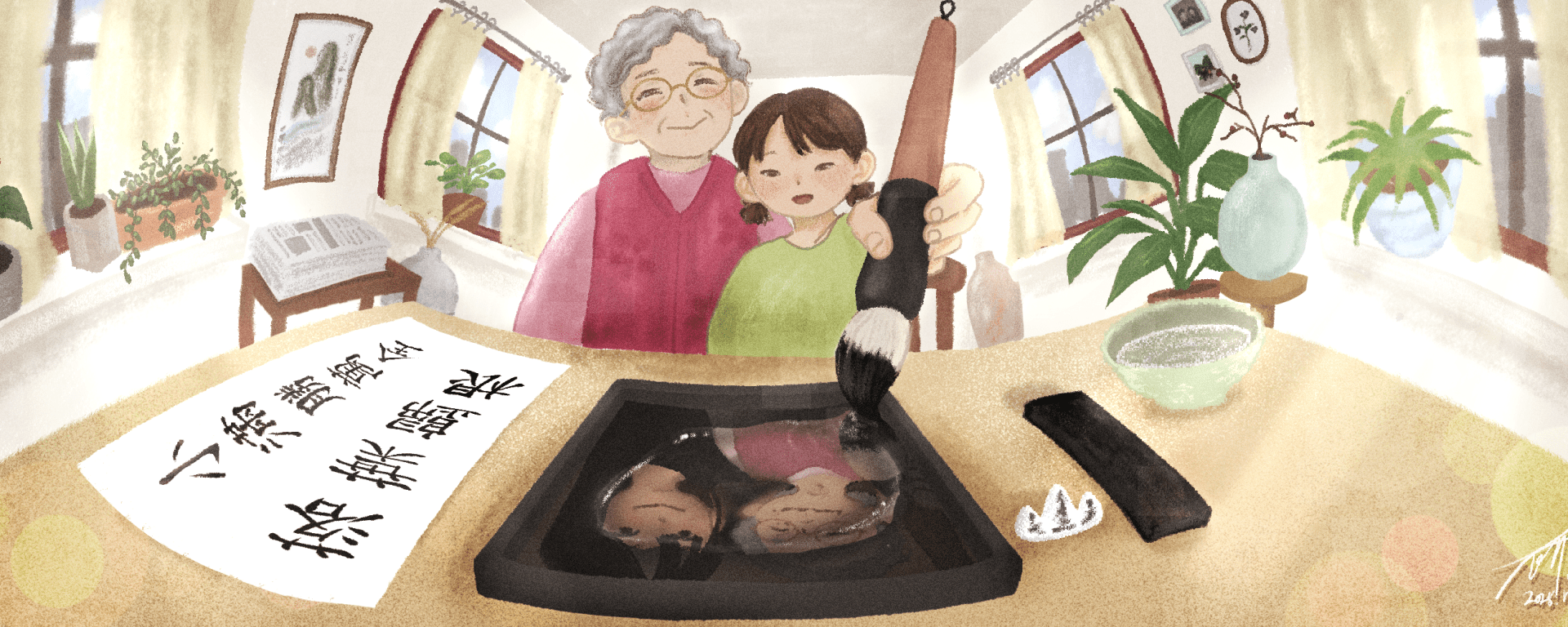
Intrigued, Jenny watched Po Po spread the paper into an even sheet on the dining table. She poured a small amount of the ink into the inkstone’s indent, swished the contents around with the brush, and rested the brush carefully on the ivory’s grooves. Then Po Po gestured to the dining table, inviting Jenny to sit in front of the calligraphy setup. Jenny sat.
Po Po pointed at each item while talking enthusiastically in Mandarin. All Jenny could do was stare blankly and nod when she thought it was appropriate. The extent of her Mandarin barely ranged from “I have to go to the bathroom” to “I like to eat wontons,” but she gathered that Po Po was explaining what each object did.
Po Po took the brush and held it perfectly vertical, her wrist and elbow hovering above the table. Then she handed the brush to Jenny, who tried to mimic Po Po’s form. The brush was much heavier than a pencil, and it wobbled in her grasp.
Po Po murmured something encouraging. She placed her hand over Jenny’s, her grip iron as she guided the brush towards the inkstone brimming with ink. Jenny watched Po Po’s veiny hand expertly glide the brush over the paper to create a fluid, even stroke. It seemed like she had done this a million times before.
Then it was Jenny’s turn to try on her own, without Po Po’s steady hand to help her. Carefully, she dipped the brush in ink and began with a horizontal stroke. But she’d pressed too hard on the paper. What was meant to be a thin line came out as an inky blot.
Po Po offered a few pointers, and Jenny nodded uncomprehendingly. After several more tries, she finally produced a respectable stroke. Po Po smiled in approval.
The afternoon whirled by. By the time Jenny’s mother came to pick her up, her head swam from trying to imitate Po Po’s flawless technique, and her hand cramped from gripping the brush too hard. How did Po Po make calligraphy look so easy? Had she begun learning at the same age as Jenny was now?
“Well!” Jenny’s mother admired Jenny’s handiwork: one sheet of shakily written basic strokes and three sheets of characters, each executed slightly better than the last. “Looks like you’re going to be the family’s next calligrapher!” Po Po murmured something in agreement.
The visits always ended the same: Jenny’s mother would press an envelope of cash into Po Po’s palm, which Po Po was begrudging but grateful to accept. Then, in a flurry of Cantonese, Jenny’s mother would try to convince Po Po of something, which usually ended in Po Po lightly laughing at the proposal in dismissal.
Finally, the three of them would finally say their goodbyes. But in Chinese, there was actually no phrase that truly meant “goodbye”; the closest phrase translated to “until we meet again.” “See you in two weeks!” They’d say. “See you soon!”
 Katie Tan