⋅•⋅⊰∘⋆⋅☆⋅⋆∘⊱⋅•⋅
“Alright, guys.” I heard the familiar tapping of a baton on the stand. “Let’s warm up with a B-flat scale.”
I put my clarinet to my masked face, but the motion was too fast. My mouthpiece grazed the cloth covering my mouth and I winced as I heard the reed chip.
I sighed, reaching inside my case for another reed to replace it. Playing with a mask was going to take some getting used to.
It was August 2021, the beginning of my sophomore year. Surrounding me were my new bandmates of the Duke Wind Symphony: many first-years and sophomores and a handful of upperclassmen. All of us were mostly non-music majors who just wanted to play for fun.
I should have felt like Wind Symphony filled the gaping musical void that had been wide open for a year and a half. I should have felt more enthusiastic about playing in an ensemble again and the opportunity to meet new people. But I was a sophomore now, and work was piling up. More often than not, when I hopped on the bus to attend rehearsal on the other side of campus, I thought about how my time spent commuting and rehearsing could have instead been used to crank out my economics problem set or do some more editing on a Chronicle story.
And why should I devote so many hours of my week to music if only a smattering of people, mostly senior citizens from around the community, attended Wind Symphony concerts? The very thing that I craved and longed for the most — the electric energy from a full audience and a resonant concert hall — was missing. Of course, in high school I’d never played anywhere prestigious like Carnegie Hall, never made it to All-Nationals, and never had a chance of being a Juilliard Pre-College student. But at least with the ensembles I was a part of, I felt like I was always working towards something profound that I could share with a crowd. When I stepped onstage to a near-vacant hall in college, my heart grew heavy.
Then, there were also the never-ending responsibilities of a full courseload and The Chronicle. I could reach thousands of people with a single Chronicle story. I felt my curiosity for Duke grow like a tree with every piece I wrote, my roots extending to different parts of the University. And now that The Chronicle’s office was open, I could work alongside the editors that had guided me during my first year and mentor some new writers myself.
***
By the time sophomore year ended, I had risen to one of The Chronicle’s highest positions by becoming its managing editor. At the same time, I had packed my clarinet away for good, and with it, all my memories of rehearsals, of practice sessions, of unhinged Uno games and of euphoric concerts. My musical performance era was over.
June 2022, revisited
I am immediately bombarded with flashing headlights and deafening car horns when I step out of Carnegie Hall. But they are not enough to snap me out of my trance. I cannot believe I waited nineteen years to witness such a sensational performance — of a symphony I had also performed, too.
A couple of the New York Philharmonic musicians pass me on the street clad in all black, instrument cases slung over their shoulders. I realize with a jolt that these people could soon be some of my friends — the ones who stuck with studying music seriously, at least. Some still make time to play casually in college, while others have quit completely with their eyes set on the business world.
What about me? I am not sure. All I know is I’m here in New York City as part of the “Duke in New York: Arts and Media” program. I tell myself I enrolled to fulfill a potential English minor; but really, I wanted a summer to explore the city, to be closer to family, and to meet with home friends. And seeing the New York Philharmonic’s Mahler 1 performance (with a guest performance by violinist Hilary Hahn, no less) had not been on the list of complementary shows that my program supported. Still, I had instinctively bought the ticket and burned a large hole in my wallet in the process.
The fire that started in my wallet ignited something larger in me. By day, I take classes with other Duke students at St. John’s University; I push supply carts and staff programs at Brooklyn Bridge Park; I publish stories on The Chronicle’s website; I send my resume to various banking institutions. By night, I hunt for more music. I catch the NYPhil again at Central Park during their Concerts in the Parks series playing the Bruch Concerto with Bomsori Kim. I attend American Ballet Theater’s Romeo and Juliet and Swan Lake on Duke’s dime. I branch out to Broadway, to off-Broadway, to sidewalk dancers and underground buskers. With every performance I attend, I absorb the melodies from world class musicians; I admire the fluid movements of avant garde dancers; I see adult audience members furrow their brows in concentration and raise their brows in awe; I hear their children laughing and clapping joyfully as the performers bow.
With every performance I attend, I also sense the magic that I used to feel onstage gradually returning.
⋅•⋅⊰∘⋆⋅☆⋅⋆∘⊱⋅•⋅
There is much to do when I get back home in August. I must pack for the fall semester, order textbooks, edit The Chronicle’s massive back-to-school edition, and pick off my ever-growing list of HireVues.
I do none of those things at first. Instead, I go to the basement and retrieve a box that, over the years, my mother has filled with programs from every concert and recital I ever performed in. I open the box and slowly flip through each program one by one.
2020 All-State Band: My last honor ensemble performance.
2019 Region Band: That was the year I miraculously placed first overall and really honed my stage presence.
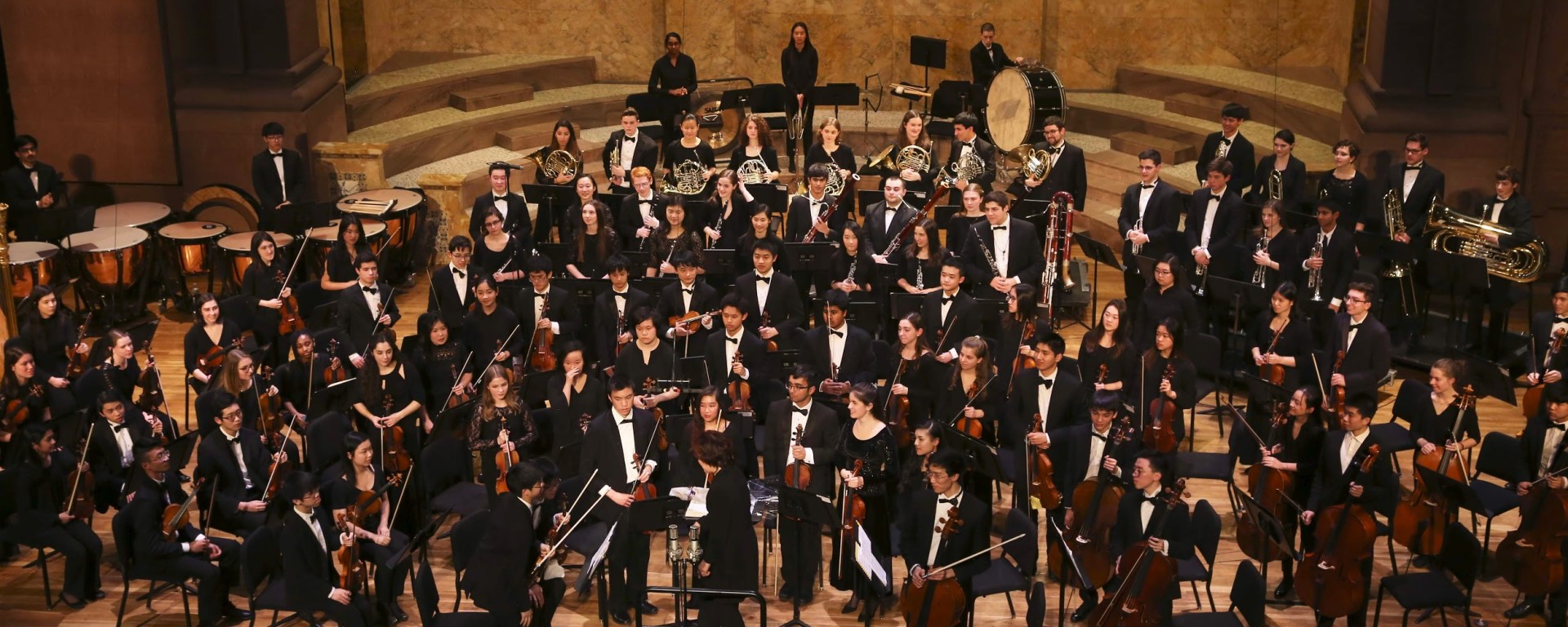
2019 New Jersey Youth Symphony: The Mahler 1 performance, of course.
2018: My first All-State experience, and the year I finally started gaining more confidence in not only my clarinet abilities but also in myself.
2017, 2016. I am halfway through the box.
2015: My first region band with Mr. Paterno, where I learned the importance of teamwork and discipline.
2014. The box is almost empty.
2013 Recital: My first solo performance, which I completely botched. I was forced to stand and play, but my clarinet was too heavy so I squeaked my way through the song. It was a formative experience, and I have always practiced standing since then.
Finally, I reach the last program in the box. 2012 Green Band: My first-ever band performance.
I open the program, which is an 8×11 piece of paper folded in half. Written inside are the names of classmates who I haven’t thought of in years, as well as the titles of the songs we performed: Fanfare and March and Lullaby. As the melodies play in my head, I remember that fateful first rehearsal when I heard all the individual sounds from the winds and brass and percussion coming together to produce something greater.
I find a surprise inside the program, too. Tucked inside is a faded photograph of me, four feet tall, glaring at the camera. I hated getting my photo taken back then, and I must have been in a rush to get to the band room to warm up.
I’m wearing the white ruffled shirt and black pants that my mom and I bought the weekend before the concert. And wait — I am also wearing white socks, even though Mr. Sorensen had specifically warned us not to! I smile to myself and silently thank him for not mentioning it that day.
Carefully, I put all the programs back in the box and climb back upstairs. I reach my room and open my closet, and sitting in the rightmost corner is my clarinet case. Hanging from the handle is a matted string of yarn and my beaten-up name tag on which I had scrawled “Katie Tan” in Sharpie a long time ago.
I gently blow off the fine layer of dust that has accumulated on top of the case and open it up. The last time I opened my case was six months ago after the last Wind Symphony concert. After practicing almost every day for years, that amount of time feels like an eternity.
Inside are five black pieces of wood with silver keys. They’re not the same exact ones that first captivated me when I was in fourth grade, but they’re still just as beautiful. I pick up the bell and assemble my way up, just as Mr. Paul taught me to do all those years ago. The pieces are a little stiff, so I smooth some cherry-scented cork grease on each of the edges. I dig around my case and find a reed — it’s a little old, but it will do — and affix it to the mouthpiece.
Then I put the instrument to my lips and play.
***
If you liked this piece, be sure to check out my pieces titled for my family and friendship, as well as the Musings and Featured pages. You can also see some related pieces I have written if you scroll past the ads.
 Katie Tan
If I had the chance, I’d go back to share the stage with you and play Mahler 1 with all those amazing musicians in a heartbeat. I miss the memories we created back in NJYS. I loved reading this, thanks for bringing me back!!
LikeLiked by 1 person
ahh thanks so much for reading Ryan!!
LikeLike