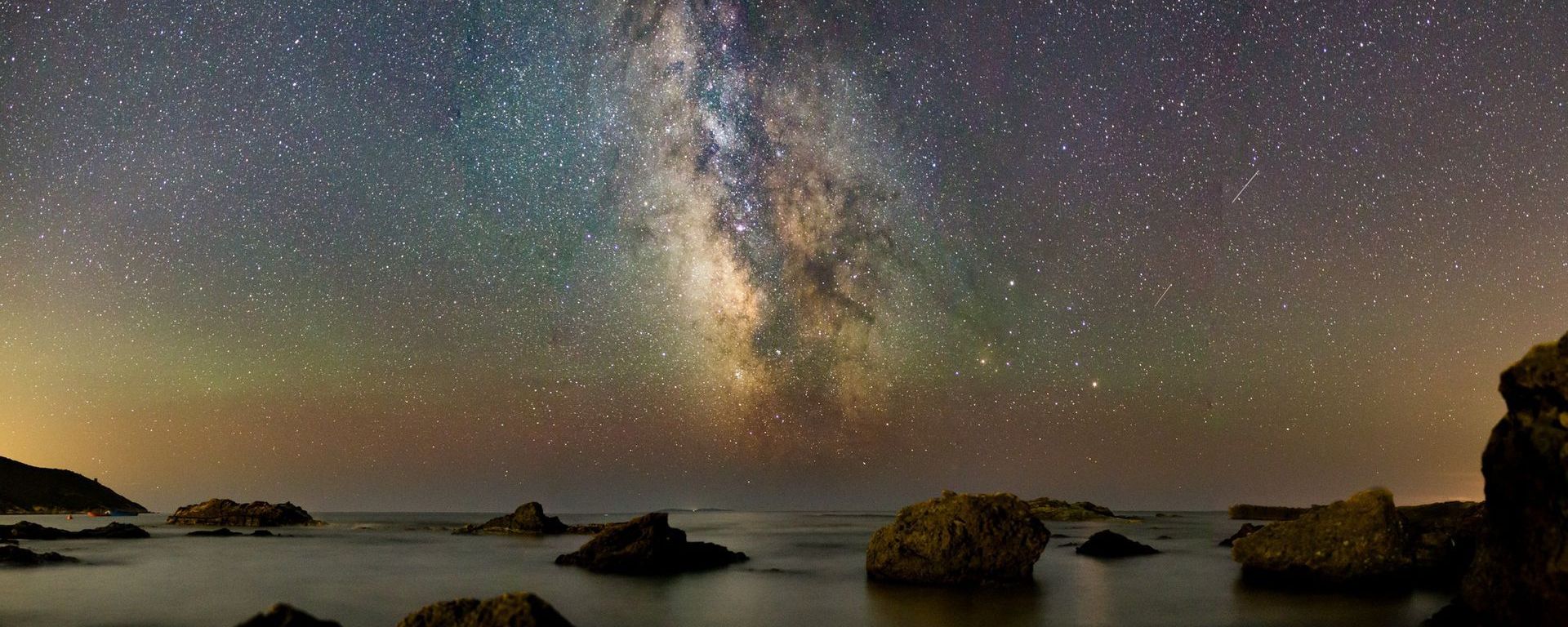
Every night, if the sky is clear, I look up. I crane my neck to see the Summer Triangle, a formation made of the stars Deneb, Altair, and Vega. As my eyes focus, more and more stars come to view, dotting the vast expanse of the night.
These glittering specks of dust are actually beasts of nuclear fusion, releasing light from tens, hundreds, thousands, and even billions of light years away. What’s more compelling is that the stars we observe are how they looked in the past. The Vega that we see today is actually how it looked in 1994. Even more fascinating is that the Deneb we see today is how it looked before Europeans laid waste on the Americas, before the Great Wall was even built, before Jesus Christ was even born.
When I look up at the stars, I feel like I’m travelling backwards in time. But in the three-dimensional Earthen experience, time only moves forward. It charges ahead purposefully and relentlessly, and with it tick away the hours, minutes and seconds of every day.
Time is not an object that can be seen moving, however, nor is it any object at all. But humans are still zealous disciples of this invisible entity. Time is used as a measurement: every home, school and office contains countless clocks, each one signaling when dinner is ready, when class periods begin and when business meetings are held. Time can become an infatuation: sprinters dedicate their entire lives to chasing down a world record. Time can be a nuisance: high schoolers jolt awake to their 6 a.m. alarms after only five hours of sleep.
Sometimes, time is dismissed as a throwaway commodity. If there’s too much, we waste entire days watching television, mindlessly scrolling through social media and brooding over trivial troubles. But when there’s only a small amount of it, we slowly drink every last drop of it like very expensive wine: savoring the last day of summer, pouring souls into a performance, parting ways with longtime friends.
Time bursts with color, emotion, and energy. It is where human existence unfolds and it is the very medium in which we live our lives.
***
But time can be cruel. The longer we live, the more tragedies we endure. Every loss we face is a knife that buries deeper into our hearts, slicing open past scars and carving wider wounds. Every loss is an earthquake where the ground crumbles beneath our feet, giving way to a thin tightrope that we hopelessly try to balance on. We torture ourselves with questions: what if we could turn back the clock? What if there was more time?
Time does not consider these questions. Time does not stop. Time does not rewind. Time only moves forward.
But time can be preserved. Photographs fossilize priceless moments and restore memories. We sit with loved ones and flip through picture after picture, album after album, gazing at smiles, laughter and happiness. Without realizing it, we are smiling softly and sadly at ourselves as we remember these moments of joy and innocence.
Time will also heal. We may not feel it at first, but it will begin to slowly mend our gaping wounds as we honor and remember the ones we’ve lost.
***
These nights, when I look up at the stars, I feel like an infinitesimal speck. To these titans of the universe, my existence will feel like barely a nanosecond: a flash, then suddenly gone.
Perhaps it’s our mortality, then, that makes time so fascinating and so precious to us. We may never completely understand it. But maybe one day, we’ll be able to see it, touch it, even travel through it. Until then, this enigma will continue to govern our lives as we try to live to our fullest.
 Katie Tan