One of Duke’s supplementary essays asked me to share an experience of mine related to a community I belonged to. Sixteen year old me presented herself as a lofty, wannabe poet; I touted myself as being an “explorer and a seamstress.” I wrote (and I both smile and cringe as I read this now), “Scouring all that my school has to offer allows me to seek out my classmates’ stories, some of whom are semi-professional yoyoers, nationally ranked fencers, and international science fair winners. As the Student News Editor of my school newspaper, it’s my job to stitch these unique stories together into one comprehensive quilt and share this multifaceted perspective to my school community.”
The loftiness and cute metaphor attempt boiled down to this: I was a writer for my school newspaper, I interviewed cool kids, and I shared their stories. But no, of course I wasn’t just any writer. I was the Student News Editor–a glorious, three-word title that I carried with pride!
In all seriousness, I truly enjoyed my job. It allowed me to stay close with what was happening in my school, and I was happy to direct my writers to all sorts of events–TedX talks, band concerts, fencing meets. But as a whole, my school’s newspaper club was more or less ragtag. Without much support from the school administration, the club was 99% student-run. It consisted of twenty or so teenagers meeting every other week during lunch, huddled around a classroom whiteboard discussing any possible story ideas. When we were not all together, Google Drive was our best friend–that was where all our editions and articles were stored, tucked away in neat little folders painstakingly labeled “JANUARY EDITION” or “QUARANTINE EDITION”. Editors like myself would make edits and suggestions to stories in our respective sections, mainly grammatical and structural ones. None of us knew what AP Style was, which is the most common writing style journalists use.
The 1% of the club that was not student run was the printing aspect. An outside company printed our monthly editions for us, and it was our school administration’s job to contact the printing company when an edition was ready. Even so, it took lots of pushing every month from us student writers to remind our administration to contact the printing company.
But when our monthly print editions did arrive, we were enthralled. In between our fingers held our month’s work, laid out in eight glorious pages of fresh newsprint. We rushed off like little mice to deliver the newspapers to everyone: teachers, students, librarians, custodians. We were even more thrilled when we saw our readers engrossed in our papers, some pointing and saying, “Hey look, there’s my quote!” Such was the work of my school’s newspaper club, just a ragtag squad of teens sharing and spreading stories to our school community. I was proud of what we were able to accomplish.
***
The conclusion to my supplement read, “I’m excited for the possibilities of stitching narratives and experiences together to enrich my life at Duke.” What I meant to say was that I promised to write for The Chronicle, Duke’s independent student newspaper, if I was accepted to this beautiful gothic university of my dreams.
The stars chose to align for me: I was accepted in mid-December of 2019, and I was absolutely thrilled. I began to dream about what my college experience would look like: picturesque and perfect, like scenes from a movie. I saw myself laughing shoulder to shoulder with my classmates as we strolled through the sprawling campus with its neatly clipped lawns and gigantic beech trees. I saw my friends and myself studying in the Perkins Library, having late night deep conversations, and impulsively taking Ubers to Chapel Hill. I saw myself taking Econ 201 in a packed lecture hall and grabbing lunch with the professor to get to know him and his research. And yes, I saw myself writing for The Chronicle.
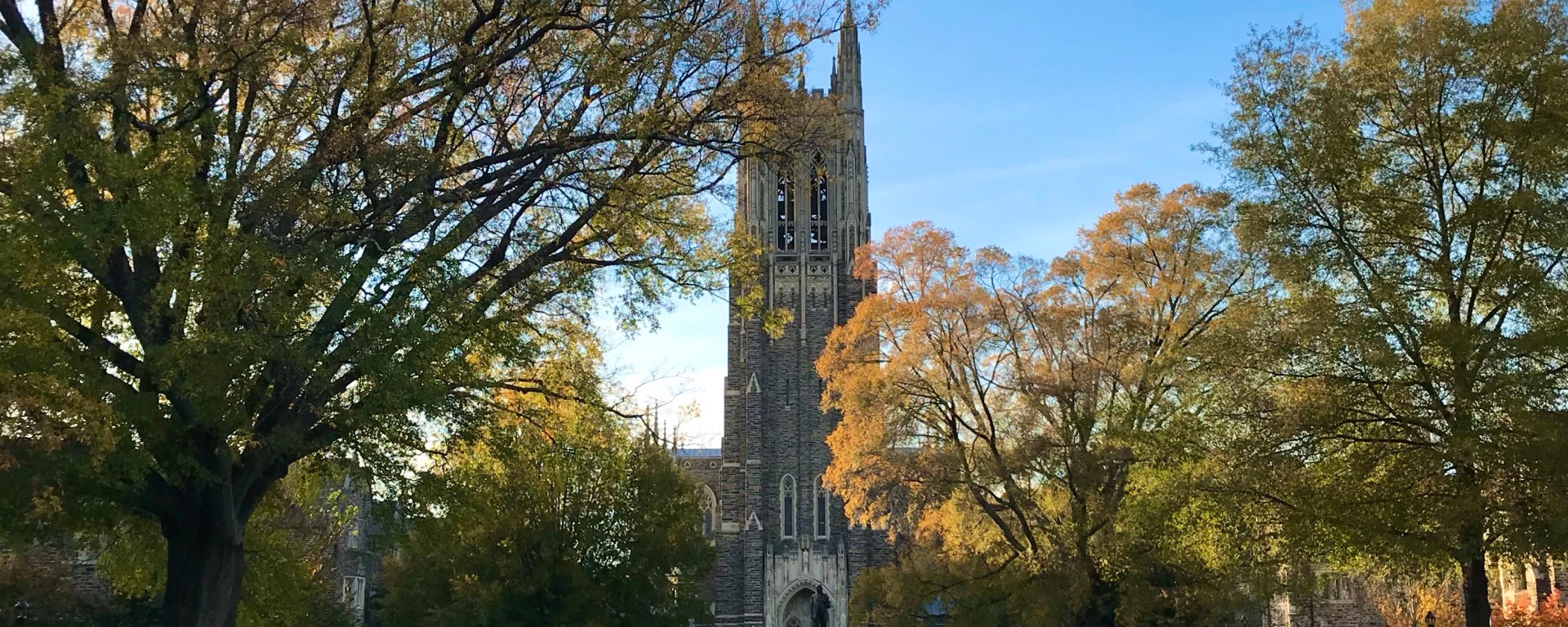
Then, the COVID-19 pandemic shattered the world. Gone was my idealized version of my college experience, replaced by hours of Zoom gloom, biweekly COVID-19 tests, and lonely dinners in my dorm. Even so, I still felt extremely grateful to be on campus. I was making friends slowly but steadily. I was able to talk to some of my professors in person and got to know a handful of the staff that worked tirelessly in the dining hall. And I soaked in this ethereal scene on every morning run: a legion of sturdy trees flanking both sides of the road, giving way to a sprawling lawn and the stately, towering Duke Chapel that grew bigger and bigger as I ran up the gentle uphill of the road.
But even after two months of being at Duke, I was still looking to be a part of a community and to truly connect with the school. I did what I knew: I joined The Chronicle, following through with my promise to the Duke admissions council.
Because I was new, I worked completely remotely at first. As such, I had no clue about the scope of The Chronicle’s network and size, which turned out to be much, much larger than I could have ever imagined. I was not operating as the amateur, somewhat powerful Student News Editor of my small high school newspaper anymore–I was now a tiny worker bee at the bottom of The Chronicle’s massive beehive hierarchy. But I was eager to write and learn, and to learn more about Duke and its people.
Each article that I wrote compelled me to speak with a different subset of the university: for one, I interviewed a fellow classmate living in the Philippines about how studying in a different time zone was affecting her first-year experience; for another, I spoke with the Chief Communications Officer about how COVID-19 tests were affecting Duke’s overall budget; for yet another, I chatted with a reverend of the Duke Chapel about how students could access the building. (Now we are pretty close, and I visit the Chapel once every week!) The more people I spoke with, the more connected I felt with Duke. I felt as if I was a tree, with each of my roots extending to a different part of the Duke community.
Every time I submitted an article to the editors, I marveled at the speed and precision with which they edited. Their little Google Docs icons buzzed around my document, making minor AP Style changes or clipping a sentence to make it more precise. Truly, watching the editors edit was like watching digital bees at work. Within the next morning, my story would be published on The Chronicle’s online platform. What a stark change from the sluggish printing process of my high school newspaper!
Finally, after one and a half months and after writing four stories, I became a staff writer and was invited to see The Chronicle’s office. This was very exciting for me–I was now truly a writer for The Chronicle, and I would finally be able to see some of the editors in real life!
***
It was a late Tuesday evening; the air was crisp and cool and stars twinkled in the night sky. From the West Campus bus stop, I made my way to the building right past the dining hall and climbed three dimly lit flights of stairs. The last flight had a bulletin board nailed to the wall with paper tacked onto it that read, “Yay, you made it to The Chronicle office!” I opened the only door available and was greeted by a space that resembled an attic: low, upward sloping walls, narrow hallways, small windows. I walked into a room that looked sort of what you would expect a college newspaper office to look like: papers cluttered everywhere, computer monitors positioned crisscrossed on shaky tables, food wrappers strewn here and there on the floor. An ancient looking vending machine stood in one corner of the room, and boxes of snacks were clustered in another. Whatever previous visions I had about The Chronicle were now met with reality. Here I was, in the physical working space of Duke’s independent student newspaper.
Five people, all college students judging by their outfit choices of tee shirts and sweatpants, were busy typing away at their computers. When I walked in, they turned to greet me. The five students were of course some of the editors–because of pandemic restrictions, only a limited number of people could be in the office at a time, and those people were usually editors working late shifts. They were so glad to finally meet another new staff writer!
Two other new staff writers joined me on my visit. As all eight of us went around the room doing cheesy icebreakers, another wave of reality hit me–I was now sitting in the same room as the same people who I had only previously known as little icons roving around my Google Docs. Now, I could finally associate real live people to the icons!
After icebreakers and a bit of conversation about which restaurant we most hated on campus, the chief editor gave us new staff writers an office tour. The office is part museum, he said, with bound volumes of The Chronicle from the last fifty years stored on the shelves, snippets of past editions taped onto the walls, and a table fashioned out of the office’s original doors that furnished the conference room. He showed us the sports section office, which had beer bottles lined proudly on one wall, the recording studio, the server that stored all of The Chronicle’s text and media, and the secret door to Page Auditorium.
It started to sink in for me: this is where everything happened! This is where the brains of The Chronicle came to meet to produce daily news for the university. I was amazed at how systematically The Chronicle operated. Imagine what the office would look like if the coronavirus went away and all the writers were here, I thought. It would be bustling with activity, papers would be passed from one person to the next, and perhaps more food wrappers would be strewn on the floor. Yes, I was seeing the beehive in person, but for now I would have to wait until after the pandemic to see the whole colony at work.
***
At the end of my visit, the editors said to me, “You can come up the the office whenever you’d like. You’re a staff writer now–truly, welcome to The Chronicle!” Then they bid me farewell, and I was on my way.
As I climbed down the three steep flights of stairs and pushed open the door to meet the cool night air, I smiled. In these past few months, I had been searching for a community at Duke. Writing for The Chronicle opened new avenues to Duke for me, many of which I have yet to write about and explore. It also has provided me with a network of writers, mentors, and potentially some really great friends. And just as a bonus: it has a really cool office. My sixteen year old self would be delighted to know that I now proudly call the Duke community my own.
 Katie Tan